Jim Bucklin
The AxJim Bucklin is Billy Devore’s school friend and accomplice in a burglary that brings the boys into the criminal justice system. The account gives little access to Bucklin’s private life or motives; instead, it defines him through what he does with Billy, what he tells police after their arrest, and the evidence found at his home. That record makes him the crucial contrast in Billy’s case: although the two boys initially tell the same story, their different circumstances allow Billy’s lawyer to separate their legal fates.
Identity and Introduction
Bucklin enters the story first without a name, as the school friend who has a car and picks Billy up after Billy sneaks out of the house. The later account identifies him as Billy’s partner in the burglary. This delayed naming makes Bucklin initially part of the episode as Billy’s companion and means of transport; his identity becomes more consequential as the case develops and the two boys’ accounts and evidence diverge.
The narrative supplies no independent account of Bucklin’s character, family life, or reasons for taking part. What it does establish is that his parents hire a lawyer, while Billy’s family is described as poor and in need of Legal Aid. That difference becomes important in court, where representation and the strength of each family’s position help determine whether the cases can be treated separately.
The Computer-Store Burglary
On the afternoon before the break-in, Bucklin and Billy go to the small computer store in the mall where Marjorie Devore works for Dr. Carney. They find a chance to enter the back of the store unseen and tamper with the door opening onto the alley used for deliveries and trash removal. Their adjustment makes the door appear locked while leaving it unsecured, preparing a way to enter later.
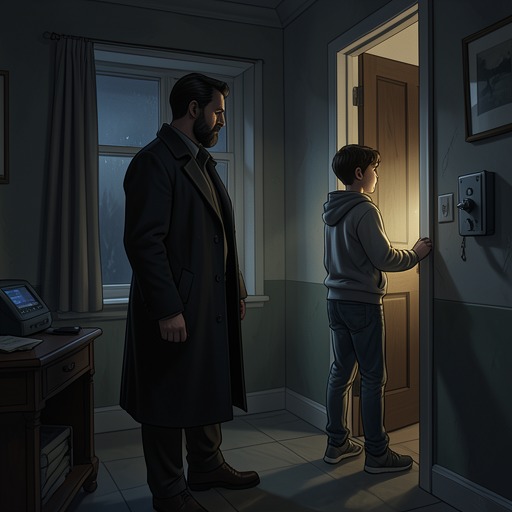
That night, after Billy’s parents believe he is asleep, Bucklin picks him up in his car. The boys return to the mall and enter through the rear door. Their method resembles the approach used in three earlier robberies at the same store. Those previous crimes have prompted the installation of a silent burglar alarm, which alerts the state police barracks as soon as the boys enter. Four police cars converge: two from the state trooper barracks and two from the local town police.
The boys are leaving with canvas tote bags full of software when the officers arrive. They abandon the bags and run, but are immediately apprehended. The abandoned goods and the silent alarm turn a planned entry through a door made to look secure into an arrest at the scene. The account does not establish, at this point, whether Bucklin and Billy were responsible for the earlier robberies; that possibility emerges later through Bucklin’s statements and the investigation.
Statements and Evidence
After the arrest, Bucklin speaks in the police car, making statements that may be understood as admissions that he had robbed the same store several times before. He reportedly continues making similar statements to detectives at the police station. His repeated talk gives the authorities material that could distinguish his involvement from Billy’s, although the general expectation is that the earlier statements will not be admissible in court.
The next day, after meeting the lawyer hired by his parents, Bucklin stops talking. He and Billy then begin to tell the same account: this burglary was their first. That alignment is fragile. When police search the Bucklin home, they find a substantial quantity of computer software. No illicit software is found at the Devore family home. The contrasting searches undermine the boys’ shared claim in Bucklin’s case while giving Billy’s lawyer a basis to argue that the evidence against the two should not be treated alike.
The narrative does not resolve the exact origin of all the software found at Bucklin’s home or report a final ruling on the earlier statements. It does show how the evidence changes the legal strategy: Bucklin’s previous talk and the search results make it harder to present him as a first-time offender in the same position as Billy.
Separate Cases and Unresolved Outcome
Porculey, Billy’s lawyer, argues that the cases should be severed. His position casts Bucklin as the more experienced offender and Billy as a good student, a poor but previously untroubled youngster led into crime by his friend. This is an argument advanced on Billy’s behalf, not a full account of Bucklin’s history; the narrative’s evidence supports the contrast in their cases, but offers no independent portrait of Bucklin beyond the burglary, his statements, and the software found at his home.
In chambers, the judge agrees to separate the cases despite the assistant district attorney’s strong objections. Bucklin’s lawyer and the prosecutor later argue for keeping the cases together, with Bucklin’s lawyer seeking to have his client benefit from Billy’s cleaner record. The judge ultimately rules against both lawyers. Bucklin’s case is held over on its own for trial or, more likely, a later plea bargain. The text gives no final verdict or sentence for him.
Bucklin’s parents are present at the back of the courtroom during Billy’s proceeding and want to speak with the Devore family. Acting on Porculey’s advice, Billy’s parents have avoided them. Burke Devore interprets their desire to talk as an effort to bind Billy’s fate back to Bucklin’s; he notices their remorseful, resentful, and reproachful expressions but does not turn to address them. The scene registers the family division created by the separate cases without supplying Bucklin’s or his parents’ account of events.
Narrative Role
Bucklin functions as both Billy’s accomplice and the point of comparison through which Billy’s legal vulnerability becomes visible. The same burglary initially places them together: they plan the rear entrance, take software, flee, and are caught. Their subsequent paths split because Bucklin speaks before consulting a lawyer and because stolen software is found at his home, while nothing illicit is found at the Devore home. Porculey turns those differences into a case for separating the proceedings.
The episode is filtered through Burke Devore’s account of what he learns from Marjorie and the legal proceedings. Bucklin is therefore known chiefly through reported statements, police action, evidence, and the arguments of lawyers. His case remains pending as Billy receives a sealed indictment and leaves court with a chance to avoid a lasting felony conviction if he stays out of trouble. That contrast is the clearest consequence of Bucklin’s role: he helps expose how the same arrest can lead to sharply different prospects, while his own eventual fate remains outside the account.